Holistic Review: Part allegory and part adventure thriller, Vengeance on Varos is thought-provoking and highly entertaining.
There's a lot to be said for mindless entertainment. Sometimes, at the end of the day, all you want to do is crash on the couch and watch cartoons. Or, at most, a sitcom with lots of jokes and one simple moral lesson. But the most satisfying television and films, without question, are the works that pose thoughtful questions that make us reflect on our lives and our culture. It's hardly required in order to make a story good, but a story is always elevated when it works on multiple levels. For me, that's a big part of the reason why Vengeance on Varos is successful.
The most obvious social critique in Varos is what everyone always says the story is about: the "video nasty", a term that never made its way to the US, probably because we were too busy churning them out in the 80s. My cousin Gray grew up on a diet of horror films, secretly devoured late at night with friends, and to this day he has a far higher tolerance for slasher films than I do. (My friend Sander, who keeps trying to get me to watch something called Midnight Meat Train with him, puts us both to shame.) Varos takes the contemporary cultural appetite for slasher films and extrapolates it into a society that watches actual executions. And not mere perfunctory firing-squad executions, but agonizingly slow deaths in a variety of ways. Frighteningly, these appetites aren't limited to Varos alone; the Chief Officer says that "the recording of their final agonies will sell on every civilized world." It would be easy to take issue with his use of the adjective "civilized", if not for the fact that there are plenty of people in our own 'civilized' countries who would be just as eager to watch snuff films, if indeed such films existed.
Although widespread exposure to (and approval of) violence — still a highly relevant topic today, particularly when discussing the effects of video games on children — is Varos' primary and most conspicuous theme, it's far from the only societal ill that the story targets. In particular, the inherently flawed political system of Varos provides fertile ground for the script's critiques of our own society, which resonate just as deeply today as they did during the eighties.
Whoever set up Varos' system of government clearly wanted the residents (then prisoners) to feel as if they had some freedom, while secretly working to make sure they did not. On one hand, they have a democracy, in which every resident is given the opportunity to vote on every change that the governor proposes, and decisions are made based on the majority opinion. Governors who propose popular changes are rewarded; governors who propose unpopular changes are slowly... removed from office. (The problem being, of course, that the right decision or the best decision isn't always the popular one, as Varos repeatedly illustrates.) At which point a new governor is thrust into office, feeling no doubt entirely unmotivated to propose the drastic changes that might actually help everyone, and thus the cycle continues. However, on the other hand, voting isn't a privilege; it's compulsory, as is much else on Varos. The punishment for failing to vote, voting too often, or voting for someone else is banishment to the Punishment Dome, and almost certain death, unless the governor sees fit to grant a pardon.
Surveillance is an equally prominent theme of the story. Because all of the executions are filmed for domestic and interplanetary video sales, the entire Punishment Dome is "wired", as Jondar says, with cameras recording every angle. But it isn't just the condemned prisoners who are being watched. The government (or ComDev) requires not only mandatory voting, but also mandatory viewing. Arak can't even take a nap after an exhausting day of work, because he has to keep his eyes glued to the television. This might not be a problem in some households — there apparently aren't any cameras in the private quarters — but the government encourages spouses to monitor one another, and submit viewing reports in which they can rat out the other one for shirking their duty. And it's not like there's any privacy — Arak and Etta's flimsy and barely-adequate front door (such as it is) would be more fitting in a saloon, with broad slats which passersby could easily peer over or through. All Varos lacks is a secret police force, but when the population are perfectly willing to turn one another in, who needs secret police? It certainly must damp down rebellion, not to mention their ability to trust other people. So the overwhelming impression on Varos is that you're always being watched, by the cameras or by your friends and neighbors and even your spouse, and if you don't dutifully watch your required hours of television per day, into the Punishment Dome you go.
The same punishment applies if you express any viewpoints that might be considered subversive, so free speech is apparently a ludicrous pipe dream on Varos. Besides, on Varos, "subversive viewpoints" appears to include merely criticizing the government's policies. Voting down the governor's proposals is perfectly fine, but you dare not express a public opinion on the matter, perhaps because the government doesn't want you influencing anyone else's vote (although we don't hear about corresponding punishments for praising the governor or his policies). So there's at least the illusion of freedom and democracy, but when you get right down to it, Varos is a totalitarian society that enforces censorship.
Unusually for a totalitarian society, there's nobody at the top. Even the governor, ostensibly the highest authority on the planet, is held hostage to the whims of the people and the results of the vote. No action can be taken unless the population has voted to approve it, and should the governor attempt to defy the majority decision, he will be executed outright. Elections give the illusion of freedom, but in reality they mainly serve to oppress both the population and the elected officials. The only people who can beat the system are those who manage to earn an extra illicit income in order to make life bearable. Varos' harsh, inflexible system of government means that corruption runs rife. (Not only is the government corrupt, it's also apparently inefficient, which is unsurprising given the insurmountable task of effecting real change on Varos. When Arak gets all bent out of shape that "He's the worst governor we've had since... well, since...", Etta shrewdly reminds him: "Since the last one?")
The question of how to treat prisoners is a more subtle concern in Vengeance on Varos. This probably resonates more with a US audience, where capital punishment is still a hotly-debated issue. Overcrowding in prisons is a serious concern, and some citizens don't appreciate having to pay taxes to give condemned criminals three hot meals per day when we could just feed them cold gruel instead. There are those who would prefer to lock criminals up on an island somewhere — like Alcatraz, or Australia, or indeed Varos itself — or simply execute any and all murderers and have done with it. The feeling is understandable — it corresponds to the prevalent "eye for an eye" belief, and it's certainly important to keep truly dangerous individuals out of society — but it poses a host of problems, not least of which is the percentage of convicted criminals who are truly innocent. And anyway, people who like to say they believe in "an eye for an eye" aren't so keen when it comes to cutting off people's hands for stealing.
There's also a hint that biased editing is a factor influencing the voting public. There's no explicit proof, but we do see editors carefully crafting the footage that gets transmitted to the populace, and certain viewpoints are espoused with the apparent aim of shaping public opinion. If surveillance on Varos is as ubiquitous as it seems, then it wouldn't surprise me one bit if the government were burying footage proving that some of their political prisoners, like Jondar, were not actually as seditious or dangerous as they're made out to be. As the Doctor says, "Truth is a very flexible commodity here on Varos, Peri." We certainly wouldn't know anything about that ourselves, what with our 24-hour news channels that are never accused of distorting the facts, and our reality shows where everyone is always portrayed true to life and the producers' opinions never influence the results of a public vote.
While most of the story's message arises from a pointed critique of Varosian society, the one outsider — Sil, representing the business interests of Varos — enables the story to turn its lens on the topic of corporate greed. Although the Varosians are working on exporting their execution videos to depraved viewers on other planets, their primary industry is still mining. Unfortunately for Varos, its main export — zeiton-7 ore — is considered to be "worthless" by the natives. There appears not to be much of a demand for it, to be honest, except from time-travelling cultures who use the metal to power their time machines, and for them it fetches a high price indeed. Unbeknownst to the Varosians, of course. Sil keeps them unenlightened, literally laboring under the pretense that he's paying them a higher price for zeiton than the market warrants. It's Sil and a lucky few Varosians who pocket most of the profit from this enterprise, while the Varosian proletariat wallows in poverty, worked to death by the government in exchange for meagre rations.
It is perhaps disheartening that Vengeance on Varos is actually less allegorical now than it was, because our own culture has grown more similar to Varos since the story first aired. Slasher films have escalated into the "gore porn" category, so called because they're little more than an excuse for an endless parade of scenes detailing horrifically realistic torture, blood and guts. Surveillance cameras have become omnipresent, much to the dismay of people who decry the formation of a "Big Brother" state, and that's before we even touch on online tracking, corporate data mining, invasive airport security scans, and wiretapping scandals. Prison reform is a perpetual topic of heated debate. (Do we put prisoners in comfy cells with good food, television, exercise rooms, etc? Or should they feel the full force of their crimes with bread, water and thirty minutes of outdoor exercise per day? Should capital punishment be abolished, or is it a necessary evil? Is it any less cruel than, say, Lexx, in which criminals were carved up while alive and fed to living spaceships? And what do we do about the unjustly accused, who are subjected to the same punishments as the justly convicted?) Both sides of the political spectrum are constantly accusing the other of biased reporting and media distortion (in the US, the Fox News channel so beloved by conservatives is the most frequent target for accusations of blatant misinformation), and then there's the question of how much we're even told about what happens outside our borders, with some news stories reportedly being suppressed or censored. Greed is one of those vices that never goes out of style, but we've seen it plumb new lows in recent years, with wealth disparity a major issue, US banks paying six-figure executive bonuses even after being given bailouts, and financial crises impacting the economies of entire nations. Thankfully, the English-speaking world hasn't yet gone down the path of totalitarianism, but I venture to say that all of us could lodge complaints against our respective corrupt governments.
The ubiquity of television may not have been a major issue when Vengeance on Varos was produced and terrestrial UK television only offered 4 channels, but it very much foreshadows today's concerns, now that hundreds of digital channels are available at the touch of a remote. On the whole, Varos' TV consumption is treated as fairly unremarkable. It's literally their only source of entertainment, after all, plus it's the method by which they can influence politics. It only seems extreme, from our point of view, because the government mandates constant television viewing; and then we learn that, appropriately, the people of Varos worship "the great Video". In our own society, the debate about whether very young children should be allowed to watch TV, how much time should be allotted for children to watch TV, whether it's okay for the television to be used as a reward for good behavior or a virtual babysitter when parents are busy, and whether kids should be allowed to play video games or be forced to play outside, have only grown since the 1980s. While we're not yet glued to our televisions (or our computers) to quite the same extent as the people of Varos, and we don't literally worship entertainment media as a deity, some of us aren't far off from those extremes. (And I say that as a guy who has been addicted to his weekly sci-fi TV shows — not to mention online chats, Facebook account and smartphone — for years...)
But there's a lot more to enjoy in the story besides its layered plot. For all the weighty issues it presents, Varos escapes being a preachy snoozefest by pumping up its lurid side. As surprisingly interesting as the political intrigue on Varos is, the Punishment Dome and its nefarious series of deadly traps capture my attention far more. I don't suppose it will come as any surprise to anyone who's read my reviews that maze/quest + traps is pretty much a guaranteed win in my book, and Vengeance of Varos does it right, both by including some memorably creative methods of execution and by incorporating the element of uncertainty, which keeps viewers on their toes. (Not to beat a dead horse, but you've seen me mention Cube before, right...?) These scenes are fraught enough all on their own, but the tension is heightened even further through the use of moody lighting, most notably the unexpectedly-unsettling violet light signifying the hazardous Purple Zone, and also through Arak and Etta, who know more than any of us about what's going on and say worrying things like Arak's morbidly eager "I wonder if they know what's waiting." Because viewing is compulsory, you'd think that after a while, everyone on Varos would know all of the traps in the Punishment Dome, so when they got thrown in, they'd be better-equipped to figure out the safe route, if one existed (although as far as we're aware, not a single person has ever successfully found it). So the impression is that someone — likely Quillam — is in charge of developing new and ever-more-devious traps with which to outfit the Punishment Dome, not to mention installing and uninstalling the traps, and presumably shifting around the maze of routes. That can't be cheap, so they must spend a great deal of money from the video sales on these upgrades. (Then again, this may not be the case; Bax claims "The prison contains too many devices. No-one could know or survive them all.") Of the traps in the Punishment Dome, my favorite is probably the room of poisonous vines, which is genuinely fatal and makes for a tense scene as characters step gingerly between the dangling fronds, knowing that the slightest touch means death. (If it were me, I think I'd be crawling through that room rather than standing upright!) Hypothetically, I also really like the idea that the Punishment Dome is inhabited by (presumably) former condemned prisoners who have gone savage, abandoning any attempt to escape and resorting to cannibalism in order simply to survive (and in the Dome, they're not likely to be short on food). In practice, though, the cannibals look a bit too clean and un-bloody and somehow not entirely scary. I think what it boils down to is, they don't look fierce enough. Still, their ruthless behaviour drives the point home, as one of them drags off his fallen comrade for dinner. (Apparently they're not too bothered by a few plant toxins in the bloodstream!)
What's fiendishly clever is that by making us participants in this display, Vengeance on Varos makes us partially culpable ourselves. It's all very well for us to sit back at home and excoriate Varosian society for deriving pleasure from the loss of human life, but people in glass houses shouldn't throw stones. How much better are we? We're watching exactly the same program as the Varosians and we, too, get caught up in the drama of it. How many people shed a tear at Quillam's death, or even the acid-bath attendants', and how many people cheered? How many of us thought maybe they deserved to die? Sure, the deaths we're watching are fictional rather than real, and that makes a world of difference, but shouldn't we be a little bit disturbed by how much enjoyment we can derive from watching bloodshed? Does it desensitize us to death? I'm not the sort of person who believes that video games are directly responsible for tragedies like school shootings or serial killers, but by the same token, it's hard to imagine that it has no effect. The same goes for our own television and movies, which are filled with depictions of violence and murder. A friend of mine often worries that her young son watches too much Transformers and, now that he's starting school, all of his games are about people fighting and being enemies. So, I really appreciate that while Vengeance on Varos makes its horrific plot entertaining, it rightfully makes us feel a little bit dirty for enjoying it so much.
One other major strength of Vengence on Varos is the script's thoughtful extrapolaton of how society in a futuristic ex-penal colony might develop. Thanks to all the work Philip Martin puts into world-building, the story gives us a pretty comprehensive picture of life on the planet in an hour and a half. No doubt it helps that there's not a lot to life on Varos, but the simplicity of day-to-day existence doesn't make it any less brutal. Even for law-abiding citizens, the day must be a drudge. There appear to be only four industries on the planet: politics; security; mining, a laborious manual task that, despite advances in research and development (which have also led to experimental technology like Quillam's transmogrifier), is a dying industry; and video production, which appears to be supplanting mining as Varos' primary industry and exporter. After work hours, we see no signs that anyone has a social life. Jondar had a friend, but what did they ever do together? Probably they sat around and watched TV, since that seems to be the only thing anyone's allowed to do when they get off work. They don't even need to leave the house to run errands, because meals are delivered directly to their living quarters. Dull, dull, dull. With most of the population trapped in a neverending cycle of work / television / sleep, with no hope of conditions improving — because the corrupt élite class earn all the money, none of which makes its way down to the workers — and the government consistently failing to reform society for the better, it's no surprise that Varos has never moved beyond the brutal traditions from its founding years as a prison planet. Aside from his impressive world-building, Martin also turns in a script that, for the most part, is impressively polished. It's by no means perfect — some of the dialogue clunks rather loudly — but there's no shortage of witty, poignant and clever lines. In particular, I love the irony in Bax unselfconsciously reminding the Governor "You said we must export or die," when the 'export' in question is a video of Jondar's execution. I may have some minor-ish concerns with Martin's script, and I may loathe his next story, but with Vengeance on Varos he's firing on almost all cylinders.
Where the story has a downside, it's in one of two areas: the plot, or the acting. When the plot is good, it's very good. The social critique, as we've discussed above, is insightful and forward-thinking. However, the script does some things that are a bit counter-intuitive, or just plain sloppy.
For all that I've talked about Vengeance on Varos deliberately making us feel uncomfortable about watching and enjoying television violence, the story does find itself in a rather awkward position. Its stated message is directly at odds with the rest of the Saward era, which has a tendency to glorify graphic gratuitous violence. That makes Vengeance on Varos a great fit for season 22, but perhaps it fits a little too well. Some might even call it hypocritical. The majority of criticism levelled against Varos has to do with the portrayal of the sixth Doctor, who just last week wielded a Cybergun to blast a hole in the Cyber Leader. This week, argue his critics, the sixth Doctor causes the death of a guard and two acid-bath attendants (not to mention Quillam, the Chief Officer and their two guards, but everyone seems to think they had it coming, perhaps because it was justifiable self-defense). Personally, and as others have argued before me, I think that's unfairly overstating the case. In the first instance, the Doctor activates a deadly laser emitter and aims it through the doorway, in the hopes of deterring the local authorities from following him. It seems quite clear that the Doctor never expected to actually kill anyone with it. The beam is very obvious, and the only reason a guard is killed is because he walked straight into it, which is tragic but also a rather foolish thing to do. Still, one could argue that it was reckless of the Doctor, and the beam was easily enough avoided (if the guard had chosen to crawl under it) that it shouldn't have been worth the trouble, because it wouldn't have given them much of a lead anyway. And now they have the government of Varos even angrier at them, and able to accuse them of manslaughter. In the second instance, the Doctor is entirely unresponsible for their deaths; the second attendant knocks the first into the acid, and then the first pulls the second in after him (possibly in his attempt to escape, or possibly as a final act of revenge; it's not clear). True, the Doctor makes sure that the second attendant is in the right place at the right time, as the two of them tussle around the stretcher, but the Doctor was fighting for his life, and he couldn't have known that the man would get pulled in. These days, people mostly seem to have a problem with his subsequent line "You'll forgive me if I don't join you.", which — although firmly in the vein of dark humor — could be seen as callous. Personally, although I get why it might upset some people, it doesn't really bother me. (Nobody ever seems to comment that the Doctor also holds a gun on Quillam, but then, despite what the Doctor would have you believe, it's hardly the first time he's waved a gun at somebody.)
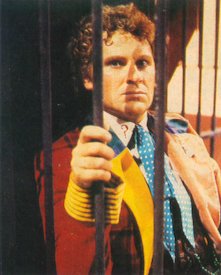
Otherwise, it's a heroic story for the sixth Doctor, who spends the entirety of Vengeance on Varos carefully studying his surroundings and deducing the best course of action. Most notably, he saves everyone's lives numerous times in the Punishment Dome, and he immediately figures out that his execution is a sham (apparently even before he noticed that the cameras weren't broadcasting). Deprived of the sonic screwdriver, the Doctor makes use of his wits and what's available: he uses a magnet to override the laser emitter to vaporize Jondar's chains, he yanks a cord out of the wall to use in short-circuiting the lights, he turns off the transmogrification ray by firing a stolen blaster at the control panel, and he rigs a trap with poisonous vines and twine. I much prefer this method, because it shows off the Doctor's creative ingenuity as well as the writer's. He has a couple of callous moments: the way he completely disregards Peri's feelings when he declares that "it's all right for" her to age and die trapped in the TARDIS, and of course that aforementioned trick with the vines, which he surely knew were fatal. But his post-regenerative tantrums and irascibility have clearly settled down, and he has some lovely moments of kindness and selflessness, as when he leaps into action to rescue Jondar. The TARDIS bickering does admittedly get old, but it's nice that we get a glimpse of domestic life onboard the ship. Apparently, rather than flitting from intergalactic restaurant to intergalactic restaurant, the Doctor sometimes makes dinner for himself and Peri! I find that rather sweet. And I love that the Doctor is still rubbing his cat badge for luck! So many great deliveries by Colin Baker, including but not limited to: "I know perfectly well what category of disaster has befallen us.", the Doctor's reaction to Peri's suggestion that the comparator is at fault (he looks at her like she's an idiot, then softens: "No. No, not this time."), "Something to pass eternity with, I suppose.", the murmurs the Doctor makes as he tries to get the TARDIS working, "The thing that depresses me most of all is that the transitional elements have lost the capacity to generate orbital energy and should be, must be, replaced.", his mildly offended "Hmm!" when Maldak shoots at the TARDIS, "I wouldn't say no to a little.", "I thought you were my mirror image until I realized that I wasn't holding a... gun?", the twinkle in his eye on "A waste of effort.", "I see. Thank you.", the painful-but-funny pun of "I think he needs more than water, Peri, eh?", "Well, a little zeiton-7 would be quite useful.", and his spectacular exit: "Now you see me..." With all the creativity and variation he imbues into his deliveries, it can never be said that Colin Baker gives a one-note performance. The man knows how to make scripted dialogue come to life. Just look at the way he handles the line "I assume there will be something novel by way of spectacle to mark my return to that state?", which would have been the downfall of half the rest of the cast. Colin Baker comes out of the story with two of my favorite promo photos of him, too: imprisoned with his hand on the cell bars, and holding out his hand to keep phantoms at bay.
Poor Peri might as well not even have been in the story, as much of an impact as she makes. She's great in the opening scenes: she refuses to let the Doctor mope around the TARDIS for eternity, she takes the initiative to find the TARDIS manual, and she's intelligent about TARDIS operation (she refers back to the TARDIS comparator from her first story, and her response to the Doctor's request for the "TR reading from the IB table" is to ask expectantly "Is that in the hypertime ratio section?"). But once they arrive on Varos, Peri's frustratingly written as the stereotypical helpless female. She follows the Doctor around through trap after trap, she's captured and taken to the Governor where she's repeatedly interrogated, she's handed over to Quillam to be experimented on, and then she's forced to stand helplessly by the Governor's side while he's (nearly) put to death. Throughout this ordeal, Peri does nothing proactive except attempting to explain. She doesn't even demonstrate any of the unintimidated spirit she showed on Sarn; on Varos, Peri cowers before the Governor and Sil, and seems barely able to compose a coherent thought through her nerves. Peri does kindly offer to speak the people of Varos on the Governor's behalf, which nicely illustrates her desire to be helpful, but that's literally her only good moment on Varos. I love Peri to bits, and I love Vengeance on Varos to bits, but this story is a textbook example of how badly Peri was served by the production team. She seems to be little more than eye candy in a leotard and shorts, whose sole purpose is to get into trouble so the Doctor can rescue her. There's a whiff of misogyny about the story — which, combined with the discomfiting fact that Sil's two handlers are black, and that both these issues are raised again even more strongly in Mindwarp, makes me slightly wary of Philip Martin's scripts.
I always enjoy hunting down the lines that sound really weird coming out of Peri's mouth, and while overall Philip Martin writes naturalistic dialogue for her, she still gets a few clunkers: "If you recall, last night I was supposed to have a cold supper!", "I don't know what that is or even what he says!", "Our TARDIS, that box thing outside, is, if you like, a ship of time.", and perhaps my favorite from her entire tenure, "A creature from my worst imaginings!" A couple of Nicola Bryant's deliveries feel stagey — mainly when Peri turns on her sanctimonious voice, as on "a near collision with a storm of asteroids" and "You even managed to burn dinner last night." There are also a few accent slips, most notably on the line "Water." which unfortunately gets repeated four times. I was amused by the line "Why did that man far at us and then turn away as if we didn't exist?" in which it appears that Peri is from Pensacola rather than Pasadena. At least the producers allowed her to say "zee" (which leads to an amusing comeback from the Doctor: "Zee? Oh. Zed.") But Bryant has some great moments in the story: her half-mock-exasperated "I don't wanna know", Peri rolling her eyes with amusement at the Doctor's melodramatic sighs, her "Hey!" as the Doctor tosses away the TARDIS manual, "Hi!" when they confront Maldak, "Well, I don't understand the technical stuff, but the Doctor said we, we must have this... special metal. To, to fix the bearings or something.", "It's the truth!", and the way she self-consciously trails off on "In fear of suffering the same death — ..." And I like her vivid blue outfit with its red belt and shoes; it's a striking, bold look for her.
The guest performances in Vengeance of Varos divide rather neatly into three categories: great, good, and meh.
At the top of the list, without question, is Nabil Shaban as Sil. Shaban throws himself into the role, committing completely to make Sil a well-rounded, believable alien character. He's also scripted as a believable villain and, despite his apparent vulnerability and helplessness, a potent threat, for three main reasons. First, he's motivated by a joint desire for power and wealth, which, if not original, is certainly relatable. Second, he's not burdened by a conscience, which would be trouble enough even without the third factor, which is that he takes not-so-secret delight in other people's pain. The mere thought of executions works him up into a blood frenzy, and with no conscience to restrain him, he wastes no time in loudly baying for the head of anyone who inflicts a perceived slight upon him. He's also got influence on Varos, and a couple of intimidatingly muscular handlers to carry out his wishes, which means that if Sil wants something done, he generally gets his way. And man, he's got a temper on him! It's incredibly fun (thanks to Shaban's performance) to watch Sil flying off the handle and foaming at the mouth with rage, but his temper, along with his lust for power, winds up getting him into trouble. Sil seems to have had a pleasant enough relationship with his business partners on Varos, despite the fact that he's engaging in secret deals behind the Governor's back. But all this comes to a halt when Sil's business deal threatens to sink, and he shows his true colors by attempting to overrule the Governor's authority. Most likely, Sil didn't think he had a choice, but it's difficult to imagine how he thought he was going to recover from that move. Along with his unpredictably volatile temper, Sil stands apart from your run-of-the-mill villain in that he's not taken entirely seriously by the script. For one thing, he's incredibly narcissistic, unable to stop admiring his slimy reflection in the mirror and cooing over how handsome he looks. Even better, his language "transposer" does just what it says on the tin, swapping around syntactic units to give Sil's English an amusingly stilted flavor. It only works sporadically, but it leads to wonderful lines like "Like this Governor we do not! Replace you must arrange most soon." and "This mysterious most is!" Because the script pokes fun at Sil, the viewer isn't inclined to take him seriously either, which makes it all the more jarring when we realize what a depraved soul lies beneath the entertaining grammar. Yet all these interesting character details pale before Sil's most distinguishing trait: the character seems designed to induce faint feelings of nausea, and not just because his lower half is decidedly wormlike. I don't know how much of this is due to Shaban's delivery and how much is due to the voice synthesizer effect, but even Sil's voice sounds wet, as if he's talking with a mouth half full of water or chewed-up food. It only gets worse when he actually eats a marsh minnow. If he were human, people would constantly be telling him "say it, don't spray it." Bleurgh. The crowning touch, of course, is his gargling laugh. It's a bold idea which, I'm sure, could have turned out ridiculous, but Shaban more than pulls it off. I'm quite sure my tongue cannot do that. Along with his squelching speech and his trilled laugh, Shaban adds lots of other little touches that contribute to Sil's alienness, like the way he calls the leader of Varos "Governyeur", or the halting way he chunks his speech — as in the line "My company / is only interested in stable situ / ations." — which might be a result of labored breathing, caused by what Sil calls the excessive "G-forces of this Varos-sized world". Shaban gives so many great deliveries, but my favorites are: "That is enterprising!", "Enough talk.", "When I control this planet, I will possess the means of power throughout this entire galaxy... and perhaps for all others beyond.", "Answer. Answer! ANSWER!", "You lying liar!", "That's all you have, Doctor!", "I'm interested in science!", his ultra-creepy "Perhaps I'll keep them in my dome as pretty pretty pets.", "Gently, gently!", "Mirror! Mirror! Mirror! Come on! Mirror! Mirror!", and his impotent rage on "Twenty! Twenty!" It's thanks almost entirely to Shaban that the scenes of Varosian politics are so watchable.
Bickering married couple Arak (Stephen Yardley) and Etta (Sheila Reid) are my other favorite characters of the story. To say that they have a "complex" relationship is putting it mildly. I'd be surprised to learn that they still love each other, given that neither one ever shows a scintilla of affection toward the other. ("Are they supposed to be husband and wife?!" wondered my friend Nancy.) They give the strong impression that they're just used to one another because they've been living together for so long. I suppose, in some ways, they're a subtle contrast with the Doctor and Peri, who bicker equally as endlessly but still care for one another. But Arak and Etta serve a much deeper function than simple comic relief; their conversations are crucial to our understanding of Varosian culture. Life on Varos is so hard to endure that it appears to be largely responsible for the extra stresses on their relationship. Arak comes home at the end of every day exhausted, wanting nothing more than to relax, have a good meal, and take a nap, much like a lot of working husbands in our own society. But on Varos, Arak doesn't have that option. Naps are out of the question as long as the single state-owned television channel is broadcasting, and the government-subsidized meals have been rationed down to nothingness. Arak can't even complain to his wife, because Etta is an obedient little rule-follower who doesn't appreciate Arak's rebellious tendencies, and is just as likely to report him to the government as protect him. ("How would they know it wasn't me voting?" Arak boasts, to which Etta vindictively replies, "I'd tell 'em!") Etta seems much more content with her lot in life, although it's not clear what she actually does all day besides knitting and faithfully watching television. She becomes so engrossed in her shows — a subtle commentary on stereotypical housewives and soap operas, perhaps? — that she barely even notices when Arak comes home in the evening. Her attitude toward Arak seems to depend on how much he's riled her up. Sometimes she ignores him, sometimes she seems to be looking for a way to get rid of him (she's not only willing to turn him in if he asks her to vote in his stead, she practically encourages him to make inflammatory statements about the government), and sometimes she tries to encourage him to obey the law (as when she warns him not to go to sleep). But she's clearly just waiting for Arak to incriminate himself so that she can justifiably turn him in. Both serve as audience-identification figures, but in different ways; it's Etta who believes in the Governor, but Arak who critizes the society of Varos. I also enjoy Yardley's portrayal of Arak as a man who just can't be happy unless he's complaining about something, even when it's something he secretly enjoys. He reminds me of those infuriating people who you can't watch TV with because they spend the entire time criticizing every little thing about it. ("Rubbish," says Arak of Jondar. "He's not hurt, he's only acting.") And he always has to be right; he's contrary with Etta even when he's clearly in the wrong ("Yes he was!"). Reid, meanwhile, gives some of the best line deliveries out of anyone in the story, including "The blind man."; "You're thinking of that infiltrator, he wasn't blind. Not at the beginning, anyway."; "Oh dear. And I really liked him!"; and the way she manages to simultaneously convey shock, horror and betrayal on her "Hey!" when Arak pushes her voting button. She does have one really odd delivery, though: "I like that one! The one in the funny clothes!"
In the "okay" category, I have a quartet of characters who are all really good in certain ways, but fail to stand out in others. On top of the heap is the Governor (Martin Jarvis), whose character has unusual shades of grey for Doctor Who. He's clearly an idealist who wants to do the right thing for Varos and its people — he is, after all, perhaps the only person who really understands zeiton's worth but doesn't want to use it for his own personal gain — and he seems like a good-natured man who genuinely cares about Peri's well-being. He just hasn't been able to stand up to the demands of life on Varos, despite his best efforts, and one gets the sense that he's been corrupted to some extent by the society he's forced to deal with. It's difficult to watch him face losing vote after losing vote and suffer the excruciating consequences, especially since he is, in some ways, just as much a victim as anyone else on Varos. It's clear, from the fact that he's required to ask permission to leave the Governor's domain, that in many ways he's only a figurehead, present to bear the wrath of the people over the impossible situation in which they're all stuck. He claims to hold final say as to the appeal against sentence of death, but I find myself dubious that he would really be allowed to spare anybody he chose. After all, his pleas for Peri's fate fall on deaf ears, and he apparently fared no better with Jondar's sentence. As the Chief Officer informs Jondar, "Our governor bows to the will of his people." However, as well-meaning as he seems, he also willingly admits having a dark side. The Governor of Varos is the perpetual "good cop". He may not hold all the power, and he may not relish the idea of using force, but he's not against using his charm to manipulate people. This becomes clear when Peri is terrorized by the Chief Officer and Sil, who are threatening to have her transmogrified, and the Governor tries to calm her down by politely asking, "Why are you here, Peri? Tell me, please." He's not on Peri's side, even though he'd presumably rather not see her hurt, but he can persuade her that he is, or at least that he's the next best thing. But for all the charm and tenderness he can turn on, and as good-natured as he seems to be on the surface, when push comes to shove, he'll throw anyone under the bus. He's willing to bargain his new friend Peri's life in exchange for information from the Doctor, and for goodness' sake, he arranges to have the Doctor killed because he knows it'll prolong his own life. A saint he is most definitely not, yet he's the best hope Varos has. Jarvis is very convincing in the role; I think the only reason I don't rank the Governor more highly is that Jarvis delivers all of his lines as if the Governor is about to drop from exhaustion (which he probably is). Plus he gets some weird and clichéd dialogue, like "Now death is my only friend, my constant and loving companion. Can you feel his, his cold presence?" But I like his awkward attempt to befriend the captive Peri ("Sil's language transposer has an eccentric communication circuit. But, er, don't tell him. It's my only amusement.").
Forbes Collins, in contrast, gives an almost jovial performance in the role of the Chief Officer. Alone among everyone on Varos, the Chief Officer doesn't seem to feel the pressures of the planet, possibly because he's in cahoots with Sil to line his pockets, which probably makes him the richest man on Varos. We never see this lap of luxury that has Areta so bitter, but it's safe to assume that the Chief Officer lives there. There's a strong implication that while the Governor is the figurehead, it's the Chief Officer who truly holds the power on Varos — after all, he doesn't have to labor in the mines with the lower class, and he's not part the pool of guards that can be elected governor. Instead, his position of authority remains stable through governor after governor, a transition which he alone can force through a final vote when necessary. Of everyone on Varos, it's the Chief Officer who's in the sole sweet spot. Still, although the Chief Officer smiles a lot, there's something dark behind his eyes that makes it seem insincere. I liked his delivery of "Our governor bows to the will of his people.", "Don't upset the Galatron delegate, please.", "He'd have liked that, sir.", and "Too late. Sorry." While I really enjoy Collins' performance, the Chief Officer just doesn't get very much to do, so he's not a terribly interesting character.
Quillam (Nicolas Chagrin) is one of the story's most memorable characters, ostensibly a scientist but one whose only goal is to devise new methods of torture and execution to entertain the viewing hordes of Varos. Presumably because his subjects never live to see another morning, Quillam isn't particularly concerned about little things like reproducible results. In fact, that might be the last thing he wants, given that everyone knows television audiences crave the unexpected. Some of his devices, like the transmogrifier, are so new and untested that even he's not entirely sure how they work. In the long tradition of self-experimenting (some might say blinkered) scientists, Quillam was at one point even willing to use himself as an experimental subject. One assumes that stopped when he injured his face, but for all we know, he's still using himself as a lab rat. Like Sil, Quillam is sadistic, notably in his desire to prolong the Doctor's agony for the cameras. This quote says it all: "I want to hear them scream until I'm deaf with pleasure. To see their limbs twist in excruciating agony. Ultimately their blood must gush and flow along the gutters of Varos. The whole planet must delight in their torture and death." Okay then! He's so utterly irredeemable that it's not entirely a shame when the Doctor kills him with poisoned vines. (Talk about limbs twisting in excruciating agony...) I like Chagrin's mocking delivery of "Mr Governor, sir." But he does have a terribly camp moment shortly before that line, when he stares down the Governor and, with utmost seriousness, puts his hands on his hips and retorts: "I am section controller! A permanent position. No-one orders me."
Despite being one of the most strikingly handsome actors ever cast in Doctor Who, Owen Teale spends much of his time hidden under a massive anti-hallucination helmet as guard Maldak. He has one of those faces that could be described as "angelic", so it's a bit surprising when he spends most of the story as a resolute adversary of the Doctor and Peri. Happily, by the story's end he's realized he was fated to be a good guy, and rescues the Governor from certain death. But for the majority of the story, the character isn't given a great deal to do other than wave guns at various people,
My "meh" category, unfortunately, contains two of the characters that we spend the most time with: Jondar (Jason Connery) and Areta (Geraldine Alexander). Neither are bad characters, or bad actors, just bland characters with the occasional badly-delivered line. Connery has particular difficulty with exposition, notable offenders including "Areas of ingenious danger lurk in every corner. You can die in so many varied and spectacular ways." and "The viewers applaud and shout with laughter as we poor fools walk toward certain death." But his screams and moans of pain are convincing, and he runs as though on the verge of exhaustion. Out of my "meh" category, Areta is the best character; Alexander delivers her lines with conviction, she just can't quite handle all of the flowery lines coming out of Philip Martin's pen. Her worst offender is "Varos is what it always was: a prison planet. A colony for the criminally insane. The descendants of the original officers still rule by fear, with the spectacle of death our only entertainment." which, admittedly, is challenging to say naturalistically... but then I consider Colin Baker, who can make any line, no matter how florid, sound as if he'd composed it on the spot, and I feel a little less forgiving.
If you didn't know better, you would assume that Rondel (Keith Skinner) hates the ground that Jondar and Areta walk upon. He breaks the news of Jondar's sentence with a completely emotionless "The order for your husband's execution has just been received." without any sympathy at all, even though it later transpires that Rondel was one of Jondar's best friends. The cause, I think, lies with Skinner's uninspired delivery; I offer "No. Please." as further evidence. Still, at least it's a brief role. Bax (Graham Cull) has a larger role in the story, but Cull delivers almost all of his lines in a dull monotone, as on "No-one could know or survive them all." I think Bax is meant to be a dull character, but it doesn't do Cull's performance any favors. He also gets the story's big line blunder: "Governor, may I suggest you do something to please. To entertain, to please the people."
On this viewing, it occurred to me that Vengeance on Varos has a "shut-up" count that could rival that of the Moffat years. So let's just see how it stacks up! (Never let it be said that I'm not an equal-opportunity shut-up-shamer.)
|
|||||||||||||||||||||||||||||||||||||||||
Actually, not as dramatic as I'd anticipated! But what's noteworthy is that the only people in this story telling each other to shut up are two of the main villains and the bickering couple who probably don't even love each other. The group of people who are not telling one another to shut up noticeably includes the Doctor and Peri, even though they're currently smack in the middle of the most argumentative phase of their relationship. Bravo!
I really like the exterior model shots of Varos. Between the inhospitable rocky landscape, the harsh red lighting, and the fact that the population evidently remain inside the domes rather than venturing out onto the surface, it quickly conveys the idea that Varos is not an easy or pleasant place to live. (Nancy, meanwhile, observed that it looked like the set of The Waters of Mars. By name, even! I had no idea she remembered that story so strongly.) The interior sets, dingy and shadowy, fit the same mood. Arak and Etta's dwelling feels more like a cell, with bars partitioning off the sleeping area, somber daubed walls, and beds like prison cots. In fact, their slatted front door is identical to the door of Areta's actual prison cell, so I guess we know exactly what purpose these living quarters used to serve. Sets inside the Punishment Dome are stark, generally little more than an atmospherically-lit corridor. While it slightly undermines the story's realism, in much the same way as the façades of The Happiness Patrol do, they're not inappropriate for a building in which the layout is presumably being rearranged constantly. They're certainly no less convincing, for example, than the maze corridors in The Horns of Nimon. As for props, the design of Sil's water tank is great; I'm not entirely sure how he gets into it, since the water appears to be sealed off underneath his pedestal, but the glowing, bubbling front of the tank lends the story some visual interest. I've watched Vengeance on Varos for almost 30 years at this point (good heavens!) and it wasn't until this viewing that I noticed that the cross of the Governor's medallion is actually formed by four Varos logos. What a nice touch! I've always really liked the Varos logo. I've already raved about how the story's lighting increases the tension, but I think it bears repeating that the sets are lit really well throughout. The Punishment Dome is awash with shadows, smoke drifts atmospherically through the shots of Jondar's execution, colored lights are used to great effect in several scenes... it's just a superb job.
Vengeance on Varos gives the makeup artists a chance to shine, and on the whole they succeed admirably. Quillam's makeup, a striking representation of scalded flesh, is perhaps the most successful. Even the simple beauty makeup on Peri is stunning, with blush accentuating Nicola Bryant's cheekbones. There are only a couple of iffy outcomes, but neither flops completely. Sil's costume is the first: parts of it are great and parts of it are not. On the upside, it's a brilliant design, making Sil half humanoid and half wormlike. The color, a sort of seaweedy green, fits well with Sil's water tank to give the impression that he's from an amphibious race, as does the way that his skin glistens. The segmented tail part of the suit is great, even though it doesn't look very flexible when it flops around, but everything above the waist is somewhat problematic. I applaud their desire to sculpt musculature into Sil's chest piece, but both the chest and the face seem ill-fitting. (Is it possible that the appliances were originally moulded for a different actor?) The chest piece doesn't seem to fit to Shaban's body, and crumples in odd ways when he moves; the opening in the cowl is too narrow (at one point Shaban's right eye seems to disappear under the edge of the appliance); and although I love the kelp-y ruffle around his face, the join is blatantly obvious, as is the fact that the cowl and the chestpiece are covered by another kelp-y ruffle which just flaps around, without any effort made to integrate it into the rest of Sil's body. So while the overall effect of the makeup is great, the details do let it down. Their second stumble is on the transmogrification effect: Peri's bird makeup isn't bad, and the feathers must've been a bear to lay down individually, but Areta's reptile makeup looks very cakey.
The effects are pretty standard for the 80s, but they're perfectly fine. One of the best effects is surely the pit of bubbling lava; the join is cleverly disguised using dry-ice smoke, so the illusion is very convincing. The scene of the Doctor dying of dehydration is really well done, given the limitations of effects at the time. The idea that the hallucination is becoming more convincing to the Doctor is conveyed really well by the image of the desert sands growing larger and larger until it fills the frame. (Arak's line "We got anything to drink?", as Etta sits panting beside him, reminds me exactly of my reaction when I read New Stories from the Twilight Zone, which put "The Midnight Sun" and "The Rip Van Winkle Caper" back-to-back... by the end of the book, I was dying of thirst!) The only downside is that after the Doctor collapses, the image has to think for a moment before it decides to fill in the space his body has just vacated. The least successful, albeit probably cutting-edge for the time, would be the 1980s computer font on the monitors of Varos. Dear, dear, dear. Pixellated text (and slowly-loading displays) is the wave of the future, apparently!
I'm not terribly fond of Jonathan Gibbs' incidental music, I'm sad to say. It's not terribly subtle, and there are some downright corny moments, like the music when the Doctor is moping in the TARDIS about regenerating over and over again, the completely out-of-place circus music as the Doctor reveals that the 'eyes' are green lights, or the rather inappropriate 'waugh-waugh' noises as the Doctor surveys the acid bath's handiwork. But there are some effective moments, like the thrumming base and high-pitched hum as the Doctor and company hide from the patrolling guards in an escape cell, the music as the desert illusion appears to the Doctor, and the creepy music as they navigate the green-lit end-game zone. The sound effects, however, are great, like the repeating whine of the laser emitter, which is yet another way that the story ramps up tension.
Ron Jones' direction doesn't blow me away either, but it's good. I liked the shot of the noose ropes unspooling from the pulley, and the two-shot of Arak and Etta staring at the snow on their untransmitting TV set. There are some strange shots: the camera stays focused on Jondar's shoulderblades after his head falls forward out of frame; and when he shows Peri mid-transmogrification, he's very careful not to show her un-feathered legs in frame, even though the props team have already made extra-sure by obviously hiding them underneath a silver tarp.
This is yet another story that I seem to trot out a lot to show newbies, probably because I think it's one of the best examples of the sixth Doctor's era. Vengeance on Varos was the last classic Who story that I showed my Slovak friend Martin before he moved back to Europe. Coincidentally, his last weekend in town (around 01 December 2012), and our last marathon of Angel and Doctor Who, overlapped with a visit from Gray, so we all got to sit down to the story together. Even though he wasn't Peri's biggest fan, I suspected that, as an economist, he might appreciate Sil, and indeed he did; in fact, he thought Varos was the best of the classic-series stories that I'd shown him. However, more than Sil, I think he enjoyed the scenes of Jondar being tortured; in his opinion, Varos put the homoerotic undertones of Planet of Fire and The Happiness Patrol to shame! Who'd have thought! Glad we ended on a high note. About a year later (26 July 2013), my friend Nancy and I watched it as part of BBC America's Doctors Revisited series for the fiftieth anniversary. She really liked it, particularly the story's meta-critique of TV viewers enjoying violent television, even without consciously noticing that it was satirizing reality TV before its time. I'd filled her in on the wringer poor Colin was put through during his tenure, so it was nice to learn that she had no trouble with his Doctor at all, although she was a little concerned about his casual use of violence. (She also admitted that with his boisterous coat and curly blond hair, the sixth Doctor reminded her of Liberace — in appearance, if not in attitude!) In fact, her biggest problem with the story was the Doctor's apparent lack of concern that he had lost the TARDIS, and his subsequent plan to escape the Punishment Dome through the far exit, which would appear to mean abandoning the TARDIS forever, when he could have just tracked down where they'd taken it. My poor buddy Scot, on the other hand, who never seems to be able to get into the groove of classic Who, fell asleep during the first episode. (It does start out awfully talky, before the Punishment Dome excitement kicks in, doesn't it?!) So I guess it won't win everybody over.
One last thing: I love alliteration, especially with cool letters. So even though Vengeance on Varos is a ridiculous pulp-sounding title, which has next to nothing to do with the story and isn't likely to attract potential viewers who have no idea what a Varos is, I really love it. Sil apparently agrees, claiming "I will be viceroy of Varos!" And what brilliant accident of scheduling do we have to thank for landing this story in slot 6V?
Minor points:
Arak: "Yes, he's snuffed it!"
Etta: "No... no..."
Doctor: "The TARDIS will be like — ...well. As she was."
DOCTOR: "Peri, pull him away from the wall."
PERI: (grabbing Jondar around the waist) "Like this?"
DOCTOR: "Yep, that's it."
NANCY: (laughing) "Because he couldn't lean to the side by himself!"
Doctor: "Close your eyes!"
Peri: "I can't!"
Bax: "How long should I hold?"
Governor: "And cut it... now."
Sil: (laughs evilly)
Sil: "She's laughing at us, all over the face!"
Arak: "Working men should be —"
Etta: "Yes? Yes? Go on."
Arak: "Erm. Not... taken seriously for the rubbish they may have spoken earlier on."
Chief Officer: "The results to be exhibited as a warning to women who support their men in acts of violation against the regulations of Varos."
Sil: "How dare I be spoken to like this! I will reject all offers!"
Governor: "That releases me from my people's decision to accept them. Thank you."
Sil: "Plaaaaagh!"
Etta: "I thought he was dead!"
Arak: (teasing) "No. Pay attention."
| Option 1: | [ 'zei . thɔn ] |
| Option 2: | [ 'zei . ʔn ] |
| Character | |||||||||
| Doctor | |||||||||
| Peri | |||||||||
| Sil | |||||||||
| Governor | |||||||||
| Chief Officer | |||||||||
| Total | |||||||||
The Chief Officer is clearly the odd man out here, with everyone else overwhelmingly preferring the [ 'zei . thɔn ] variant. And Peri, upsettingly, never once gets to mention it by name. Instead, she calls it "this special metal", because apparently Martin thinks girls can't memorize hard words like 'zeiton'. Pffthhhhhht. Might I remind him that Peri is doing a degree in botanical science?
Arak: "What shall we do?"
Etta: "...Dunno."
Nancy's suggestion: "Get divorced?"
Admittedly, the script has some pretty serious problems. Varos can thank its lucky stars that its considerable strengths are exciting enough to withstand the combined onslaught of an occasionally-questionable plot, an underused companion, iffy acting, and hints of misogyny and racism! But for my money, Vengeance on Varos is one of the three strongest stories of the sixth Doctor's era. It's an entertaining yet thought-provoking — not to mention dark, subversive and satirical — blend of thematically rich allegory, about a planet disturbingly similar to our own in some ways, and adventure serial, as the TARDIS crew encounter peril after peril in the Punishment Dome. As modern-day Earth society grows increasingly similar to Varosian society, so does Vengeance on Varos become increasingly relevant. I don't suppose we'd want a constant diet of hefty, meaty stories like Vengeance on Varos, but it's definitely a bar that Doctor Who should periodically aim for.